Highlights this week: 🧙♂️ Capacitors demystified ☢️ fusion-based cancer treatment and 🔬 3d printing quantum sensors
🎤 Featured Interview: Leo Chen from Engineered Arts discusses his career and the future of AI in hardware design.
🔗 Last week’s most-clicked link: A high definition Blender visualization of EMI in a stainless steel stiffener.
Interesting Links 🔗:
- ‘Capacitors Demystified’ – handy and intuitive reference from a Stanford EE133 Analog Communications course. Also from the same course, some basic soldering tips.
- An interactive, browser-based viewer for KiCAD schematics and boards. Free and open-source, supported by Partsbox, OSHPark, and more.
- One of the major limitations to Quantum Computing’s expansion is the fragmented/non existent supply base needed for specialized components – dilution refrigerators to cool to temps colder than outer space and specialized cabling needed to transmit microwave signals that control qubits (only one main manufacturer: a Japanese company called Coax Co).
- Detailed teardown of the new Valve steam deck OLED and PCB’s. Memory underwent relocation and now uses better modules, the cooling solution has had its fan flipped and thickened, and the controller component PCBs have had some consolidation and durability improvements.
- A16z’s American Dynamism 50 project spotlights the ingenuity of 50 tech companies that embody the spirit of American Dynamism – A quest to take on our country’s most pressing issues to support the national interest (think affordable childcare, reusable rockets, unsnarled supply chains, sustainable farming, clean energy, accessible housing).
- A crash course in the physics of Boron-Neutron Capture Therapy. This is a still-theoretical method of treating Inoperable brain tumors with beam-driven fusion. Fundamentally, this involves: creating a plasma ion cannon, aiming it at a heavy metal target, hitting the target (releases neutrons), neutron optics used to focus beams at the patient, and neutron + boron releases alpha particles which kills cancer cells.
- With a new lineup of MacBooks, iMac’s, and watches, Apple is finally embracing AI in the way it knows best — through hardware and the new M3 chip. Along with other hardware changes (ie 92B transistors vs 57B in the M1), it can now deliver up to 2.5 times the speed of the M1 family of chips.
- Berkeley researchers demonstrate a new 3D-printing technique for quantum sensors. This innovation may lead to novel applications in precision measurement, biological imaging and environmental monitoring. This technique allows for printing sensing elements into existing microfluidic chips, on top of advanced semiconductor devices and even cellular scaffolding, while providing advanced diagnostics for these systems.
Startup News 🚀💰:
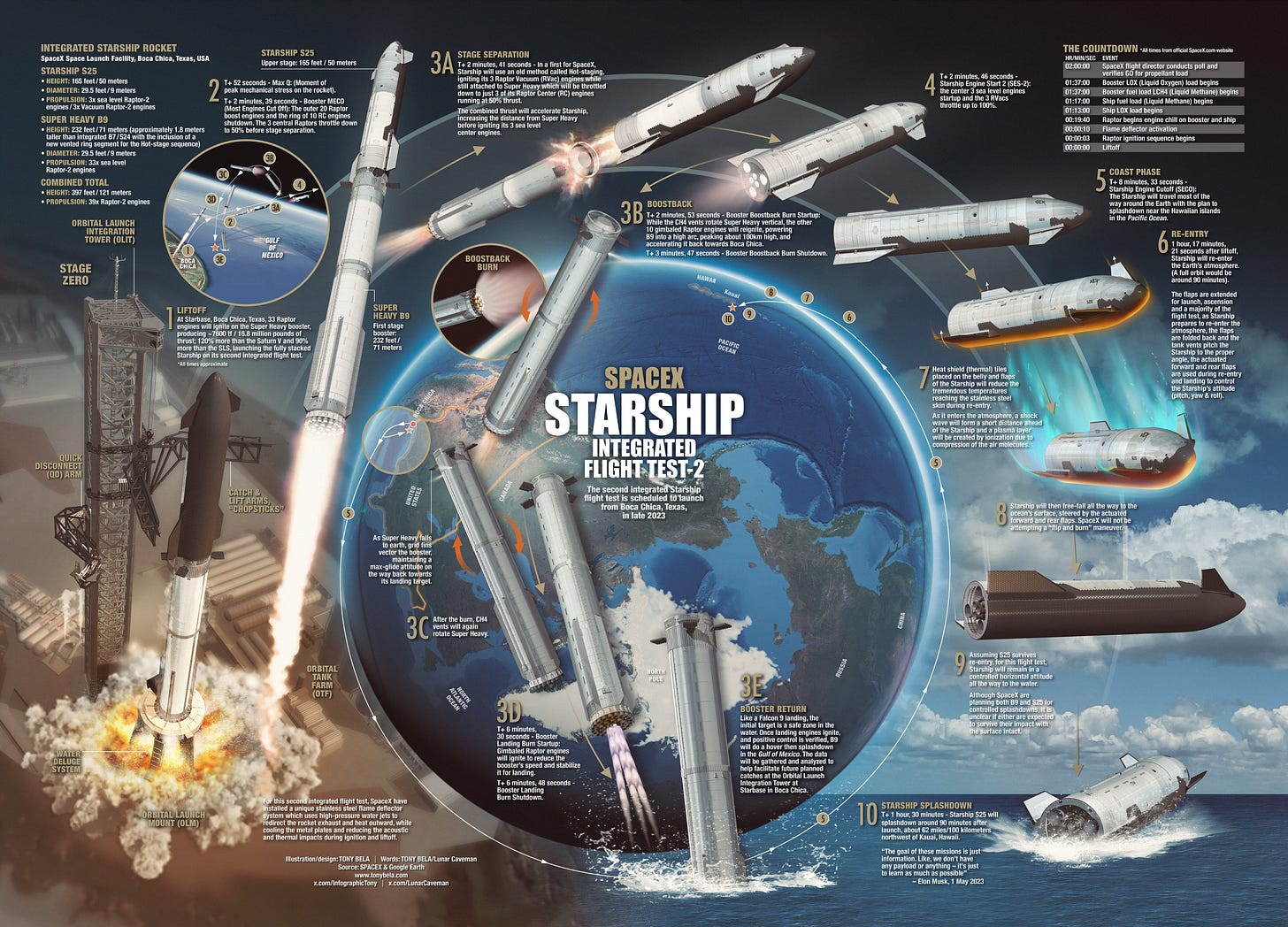
- SpaceX has announced that the Starship re-launch could happen as soon as 11/17 (see interesting photo below).
- Tech media was enamored with the announcement of Humane’s new augmented reality lapel pin that promises to bring AI to real-world experiences. The device has ambitious specifications for a 100,000 unit initial batch with 9hr battery life, 32GB storage, and a 12MP camera. Humane has raised $230M to date from firms including Kindred Ventures and Valia Ventures.
- Noya raised $11M earlier this year to provide direct carbon removal through the company’s novel electrothermal generation process.
- EV-maker Polestar launched their latest line of electric vehicles in Los Angeles this past week.
- A useful tracker to visualize tech layoffs. We have jobs below for those affected.
One Interesting Picture 📸: an infographic from Tony Bela illustrating what will occur throughout the various flight phases of SpaceX’s Integrated Flight Test-2