Highlights this week: History of Dynamite, Copper Mining Breakdown, & a Crazy CFD Simulation.
- 🔗 Last issue’s most-clicked link: Video of a crazy Indian casting ‘factory’
Interesting Links 🔗:
- Really neat video of a high fidelity CFD simulation showing a helicopter rotor in forward flight. Each blade mesh contains 5 million points and the background grid contains 4.1 billion points. 1536 CPU cores were used to run the simulation.
- How Ted Hoff invented the first microprocessor. Hoff thought designing 12 custom chips for a calculator was crazy, so he created the Intel 4004
- Ultimate Guide to Statistics for Data Science. No prerequisites required. Frequency distribution, probability, significance level, etc. Pretty useful for EE, especially in the realms of quality control, communications, and control systems.
- This former copper mine GM turned environmental lawyer wrote an incredible thread on copper mining and production. Copper mining starts with drilling. Drill rigs runs on DIESEL fuel. And they burn a lot. In copper mines, fleets of drills run in shifts, often 24/7. The drills require tires, lubricating oil, grease, dust control systems, and sophisticated electronics, maintenance, etc.
- Full-stack deep tech. Why you should sell products, not technology. Ian from CantosVC likes to invest in startups that will sell commodities––not equipment. Look at their portfolio: Twelve and Solugen sell chemicals, Mission Barns will sell food, Astranis sells connectivity, Radiant and Arbor will sell energy, Fleetzero will operate their own shipping routes.
- Alfred Nobel and the history of dynamite. Nobel, as in Nobel Prize. In 1866, Nobel discovered that mixing nitroglycerin (highly volatile as a liquid) with silica would turn the liquid into a malleable paste called dynamite. The detonator used a strong shock rather than heat combustion to ignite the explosives. Nobel went on to build the world’s first dynamite factories.
- As a separate country, the top 500 US manufacturing firms would have been the world’s third largest economy last year. Global manufacturing post-COVID grew by 7.2%. Electronic products grew from 5.9% in 2000 to 11.6% in 2022. Current employment is ~13M, the last time it was that low besides the GFC was in 1946 -- Meanwhile, the total population has 2.3x'd over that same period. Viewing this as lots of potential, now to fill those roles…
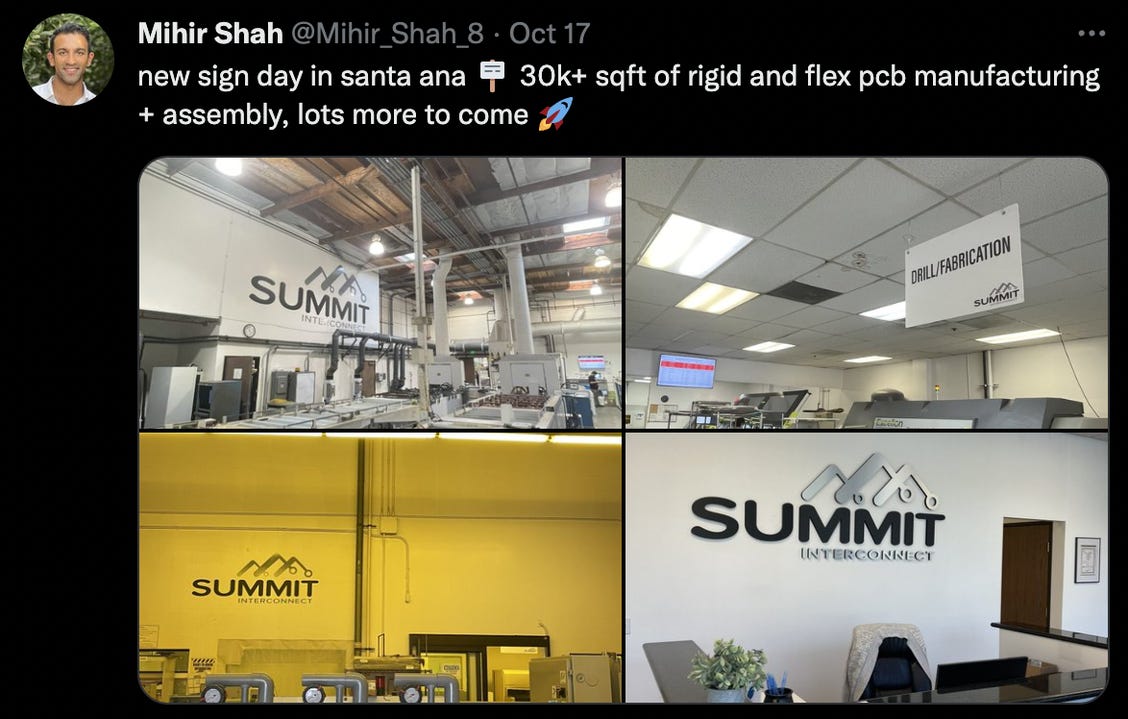
- Speaking of adding roles in US manufacturing… Factories added 467,000 jobs in the last 12 months, and factory production in September was the highest in 14 years. U.S. factories still employ only about two-thirds as many people as they did at their peak, in 1979. Back then, factories accounted for nearly 22% of all the jobs in the country. Today, fewer than 9% of U.S. jobs are in manufacturing. There’s a lot of value-add in and from manufacturing, with huge opportunities for young folks looking to join a critical industry with more of a software + automation perspective. Summit Interconnect is certainly honing in on this.
One Interesting Picture 📸: shameless plug but really proud of what we’re building