Highlights this week: 🧪 a better semiconductor, 🎤 interview with the founder of ltspice, 🏴 and british industrial history.
🔗 Last week’s most-clicked link: Ultimate Electronics Book.
Startup News 🚀💰:
- Butlr, an MIT Media Lab spinout developing sensors that use body heat to estimate office occupancy, raised a $20M Series A from Carrier Global Corporation, Tiger Global, Primetime Partners, E14, Unionlabs, Hyperplane and Tectonic Ventures.
- Qwili, a startup that provides a hybrid hardware-software sales product to micro and small merchants in South Africa, raised a $1.2M Seed led by E4E Africa.
- Polymath Robotics, a startup building a plug-and-play software automation platform for industrial vehicles, came out of stealth after joining YC’s summer batch.
Interesting Links 🔗:
- ‘Cubic boron arsenide’ > silicon as a semiconductor? CBA has very high mobility for both electrons and holes, and 10x the thermal conductivity of silicon. Silicon-carbide is already beginning to replace straight-silicon in industries such as EV due to it having 3x the thermal conductivity of silicon. CBA outperforms in both thermal conductivity and hole mobility. The challenge is to figure out practical ways of making this material in usable quantities, outside of a test lab environment.
- The golden rule of board layout for switched-mode power supplies. A good layout ensures stable functioning of the switching regulator and minimizes radiated interference as well as conducted interference. In a switching regulator PCB design, the most important rule is to route the traces that carry high switched currents to be as short as possible.
- Interesting paper on sustainable electronics design and prototyping. Group from UW and Microsoft We develop an end-to-end digital fabrication process using accessible maker tools to build circuits on biodegradable substrates that reduce embodied carbon and toxic waste. Our biodegradable circuit board sends data over USB at 800 kbps and generates 12 MHz signals without distortion. Our circuit board dissolves in water and we successfully recover and reuse two types of chips after dissolving.
- How a cable modem works. To understand the process by which a cable modem establishes connectivity, it is important to understand the protocols that are used by the various functions of the cable modem. DOCSIS protocol stack, Downstream&Upstream, Ranging, and more.
- Interesting detail into the Apple Silicon Mac boot ecosystem. Great read for more firmware-savvy folks and anyone interested in how Apple’s silicon firmware architecture is put together. It is intended for developers and maintainers of Linux, BSD and other OS distributions and boot-related components, as well as users interested in the platform, and its goal is to cover the overall picture without delving into excessive technical detail.
- Online guide/encyclopedia to British industrial history. Grace’s Guide is the leading source of historical information on industry and manufacturing in Britain. 149,536 pages of information and 235,468 images on early companies, their products and the people who designed and built them.
- New Chips Act could become a $280 billion boondoggle. Interesting opinion piece on the chips act. Despite a large focus of the bill relating to onshoring semiconductor manufacturing capacity, analysts estimate that only about 6% of new capacity will be built in the U.S. over the next few years, compared to some 40% in China. Additionally, the workforce needed to sustain the growth may just not be here: about 40% of high‐skilled semiconductor workers in the US were born abroad.
- Great interview with the legendary Mike Engelhardt, creator of LTSpice. Interesting tidbit: Berkeley SPICE (the original) had lots of problems and discontinuities for the models contained within. It also was 200000 lines of code, but only 85000 lines of code were actually used. LTspice has closer to 500,000 lines of code. Also: Power transistor manufacturers do not normally provide models because the work of creating a good power transistor is different than a normal chip designer. To help switcher designs, LT made their own power transistor.
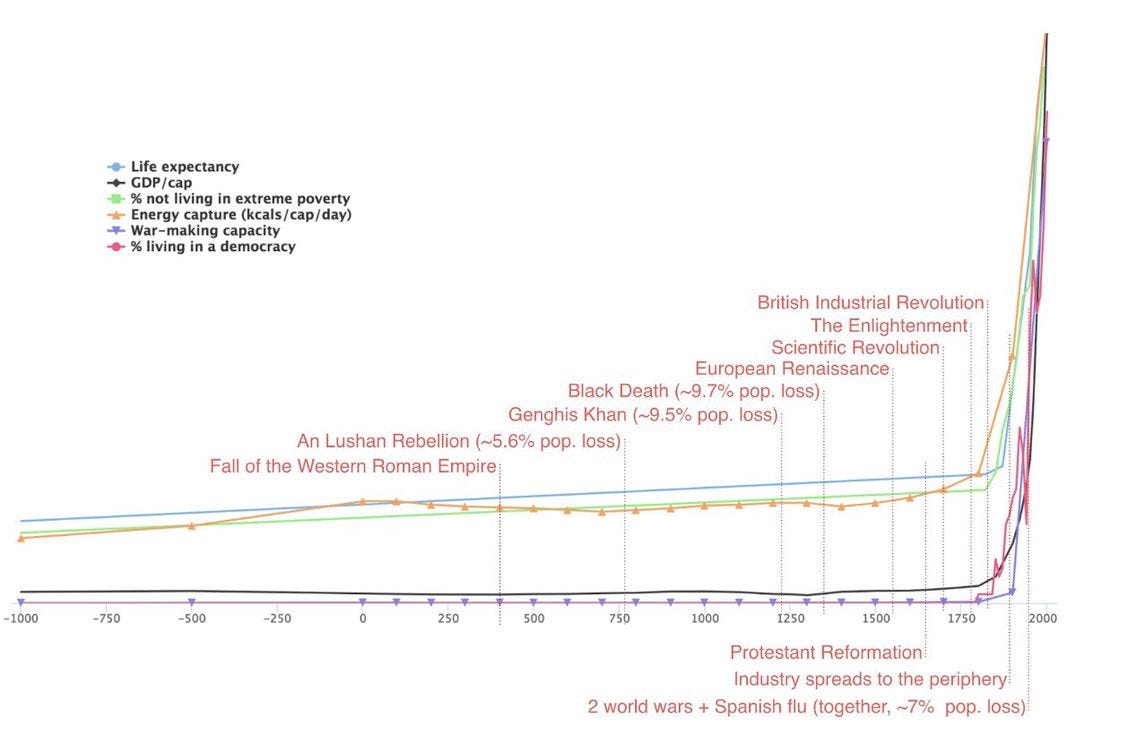
One Interesting Picture 📸: on this scale, only the industrial revolution has mattered 🤯