Highlights this week: 💡 chips for better facial authentication, 🪓 a case for splitting up intel, 🔪 and custom knife steels
🔗 Last week’s most-clicked link: Mesmerizing video of a Southwest Boeing 737 being painted into an… unexpected pattern.
⚡️ Analog Insights: TSMC Water Consumption up 80%

A large chip fab can use up to 10 million gallons of water a day, which is equivalent to the water consumption of roughly 300,000 households. A new technology, counter-flow reverse osmosis, aims to significantly reduce this and enable fabs to recycle nearly 98% of their water (<200,000 gallons of outside water instead of 10M).
Startup News 🚀💰:
- AllSpice, a collaborative hub for hardware development, closed on a $3.2 million seed round co-led by Bowery Capital and Root Ventures, with participation from Flybridge and angel investors. Look out for an upcoming interview with CEO and TheAnalog.io subscriber, Kyle Dumont.
- Athelas, a health-tech startup building remote patient monitoring technology, raised $132M in two consecutive rounds at a $1.5B valuation. The investments were led by General Catalyst and Tribe Capital. Sequoia Capital, YCombinator, Greenoaks, Human Capital and Initialized Capital also contributed funding.
- Starship Technologies, an autonomous delivery robot manufacturer, has received $57 million from the European Investment Bank, the funding arm of the European Union.
- Wandelbots, the no-code robotic software firm, raised $84 million in a Series C led by Insight Partners and featured a slate of existing investors, including 83North, Microsoft, Next47, Paua, Atlantic Labs, and EQT.
- Cellino Bio the winner of Startup Battlefield and creator of an autonomous process to create human cells, has raised $80 million in a Series A led by Leaps by Bayer, 8VC, and Humboldt Fund.
- The Electric Sheep Company, manufacturers of autonomous lawnmowers has raised $21.5 million in a Series A round led by Tiger Global, with participation from Foundation Capital.
- Paack, an e-commerce robotic delivery platform raised $225 million in a Series D round led by SoftBank Vision Fund 2.
- Jidu, an electric carmaking company, has raised nearly $400 million in a Series A funding round led by Baidu and Geely.
Interesting Links 🔗:
- If you’ve ever watched a football game, like this past weekend’s conference championship series, you’ve likely noticed the perfectly-placed yellow lines that mark first down (among others). This tech came about in the 90’s and is surprisingly more involved than one might consider. First, a 3D model is made of the field prior to the game because each football field has a unique crown and contour and is not perfectly flat in order to facilitate drainage. It also has a unique color palette, typically various shades of green, depending on the type of surface (i.e. real or artificial grass) and the weather (e.g. bright, shady or even snowing). The cameras with video that will be used with the graphics system have electronic encoders within parts of the camera assembly that monitor how the camera is used during the game. The encoders transmit that info live 30 or more times per second to the broadcaster's production truck, where it is processed by computers. Nearly all of this work is done by one company, SMT.
- Great overview of the semiconductor industry from digital to analog to manufacturing and EDA. All the key players, business models, and forecasts. Fun read from Eagle Point Capital.
- A deep-dive into CPM-Magnacut, a custom steel for use in a high-end knife developed by the author himself. This new approach to stainless tool steel design eliminates chromium carbides from the microstructure. This led to a combination of properties that are better than previous stainless knife steels, and has similar toughness and edge retention to non-stainless steels like CPM-CruWear, CPM-4V, and Vanadis 4 Extra. You didn’t know you needed this level of detail into knife steels.
- Stratechery is a great tech newsletter that recently wrote an interesting piece on Intel. Ironically, in the process of setting up a foundry to compete with the likes of TSMC and Samsung, Intel still relies on TSMC for fabricating some of its popular chips. The author calls for a split of Intel’s design and manufacturing businesses, as Intel’s designs are held back by the company’s struggles in manufacturing, while its manufacturing has an incentive problem. “The key thing to understand about chips is that design has much higher margins; Nvidia, for example, has gross margins between 60~65%, while TSMC, which makes Nvidia’s chips, has gross margins closer to 50%. Intel has, as I noted above, traditionally had margins closer to Nvidia, thanks to its integration, which is why Intel’s own chips will always be a priority for its manufacturing arm.”
- Advancing mathematics by guiding human intuition with AI. A group of researchers uses machine learning to aid mathematicians in discovering new conjectures and theorems.
- The researchers demonstrate AI’s successful application to current research questions in distinct areas of pure mathematics, in each case showing how it led to meaningful mathematical contributions on important open problems.
- An aerospace engineer hikes up an active volcano to iron a button-down shirt in 80mph winds. There is an entire sport/subculture dedicated to extreme ironing.
- A large chip fab can use up to 10 million gallons of water a day, which is equivalent to the water consumption of roughly 300,000 households. A new technology, counter-flow reverse osmosis, aims to significantly reduce this and enable fabs to recycle nearly 98% of their water (<200,000 gallons of outside water instead of 10M).
- It costs $420,000 in infrastructure costs to run Lichess, a free and open-source internet chess server. Here’s a line-by-line breakdown from the Lichess team. Note the “YoloDB we can afford to lose”.
- Startup Metalenz announced that it has created a silicon chip that, paired with an image sensor, can distinguish objects by the way they polarize light. The company says its “PolarEyes” will be able to make facial authentication less vulnerable to spoofing, improve 3D imaging for augmented and virtual reality, aid in telehealth by distinguishing different types of skin cells, and enhance driving safety by spotting black ice and other hard-to-see road hazards.
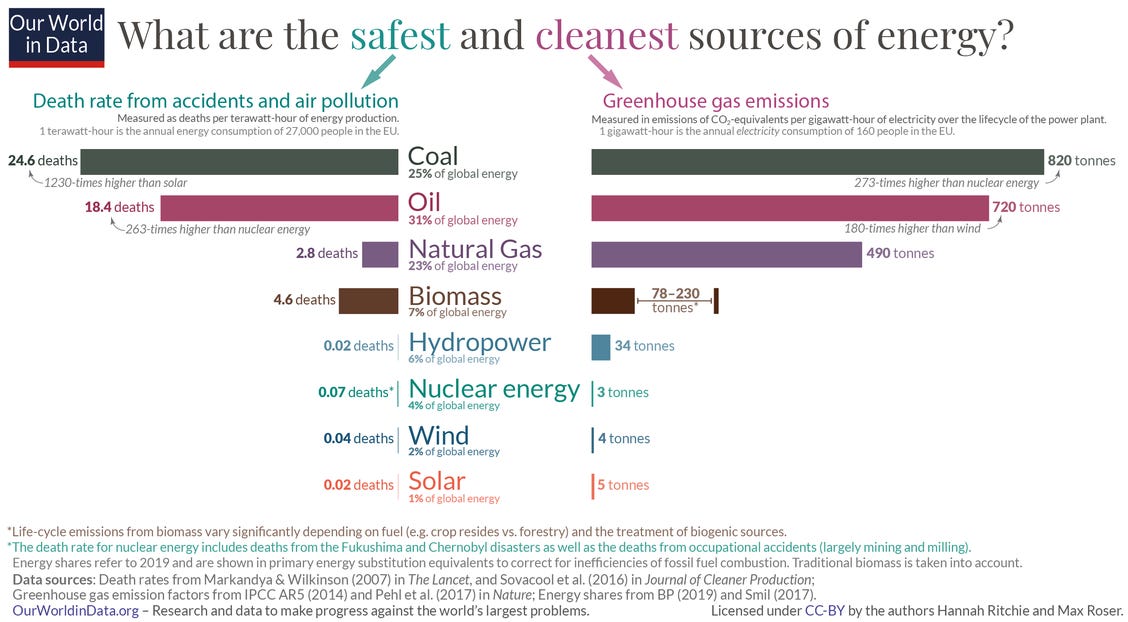
One Interesting Picture 📸: go nuclear
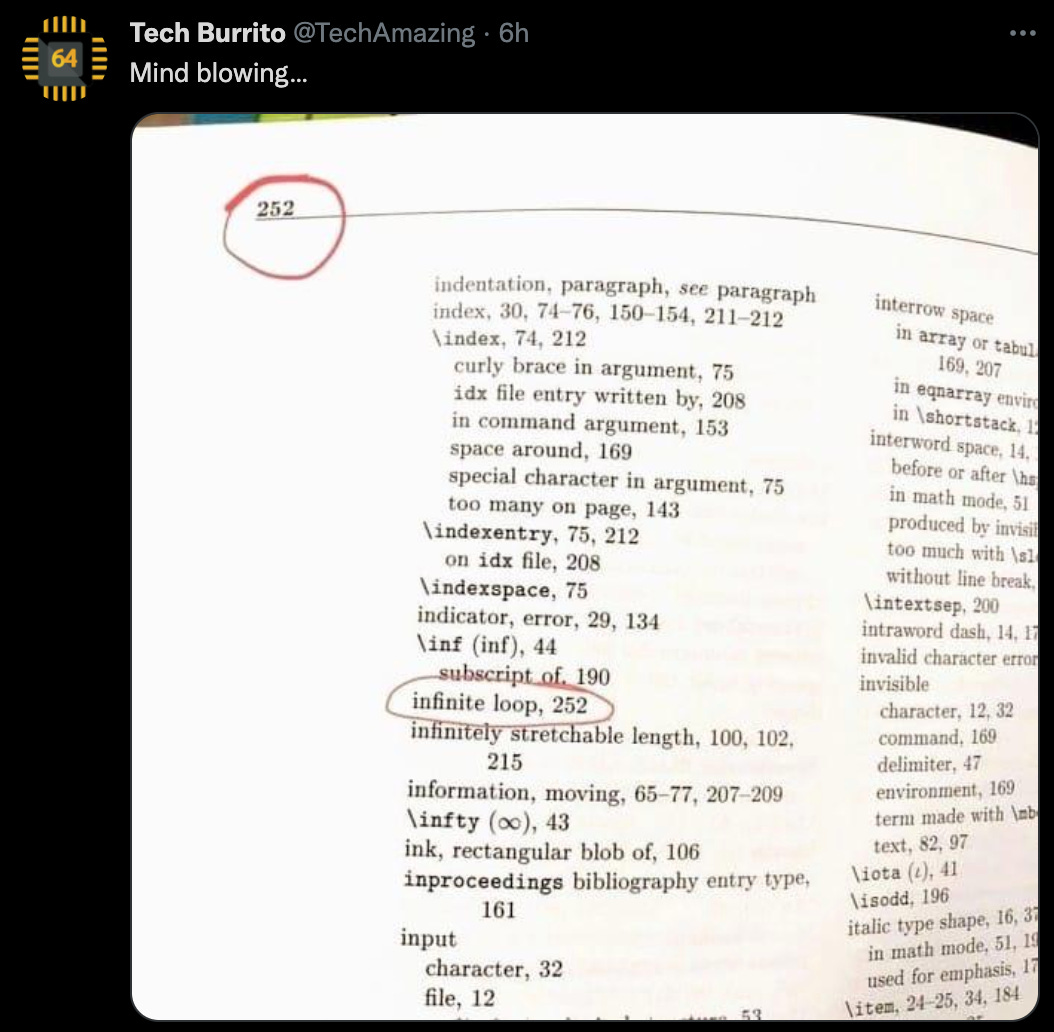
One Interesting Tweet 🐦: recursion ♾️