A handy reference chart on galvanic corrosion risk, a type of corrosion that occurs when two different metals are in electrical contact via a conductive environment (i.e. water, humidity).
What happens when you repeatedly boil and cool an egg in precise cycles? Turns out, you get the best egg you’ve ever had. Researchers at the University of Naples developed a new technique called periodic cooking, which cycles between high and low temperature exposure to prevent the egg white and yolk from separating. Periodic eggs were placed alternatively in boiling water (Th = 100°C) for th = 2 min and water at Tc = 30°C for tc = 2 min, for a total cooking time of 32 minutes, which corresponds to the repetition of the hot and cold cycles for a total of N = 8 times. In the case of periodic eggs, a bowl filled with water kept at 30°C was used for the cold cooking cycle. Here’s an example of the results using a stove from Impulse Labs.
Note: No idea if the world needs better eggs, but this could be a cool kitchen appliance: a horizontal actuator moves the basket, and a second actuator dunks it between two water baths.
A handbook of electronic system failures related to EMC issues. Every electronic system radiates electromagnetic energy—it’s just a matter of how much and where it ends up. A classic example is the early anti-lock braking system (ABS) in Mercedes-Benz vehicles. During the early years of ABS, on a specific curved section of the German autobahn, EMI from a nearby radio transmitter disrupted systems causing braking issues. ABS prevents wheel lock-up by modulating brake pressure, but EMI disrupted the control system leading to improper brake function. The short-term fix was to install a mesh screen along the affected roadway to attenuate the EMI.
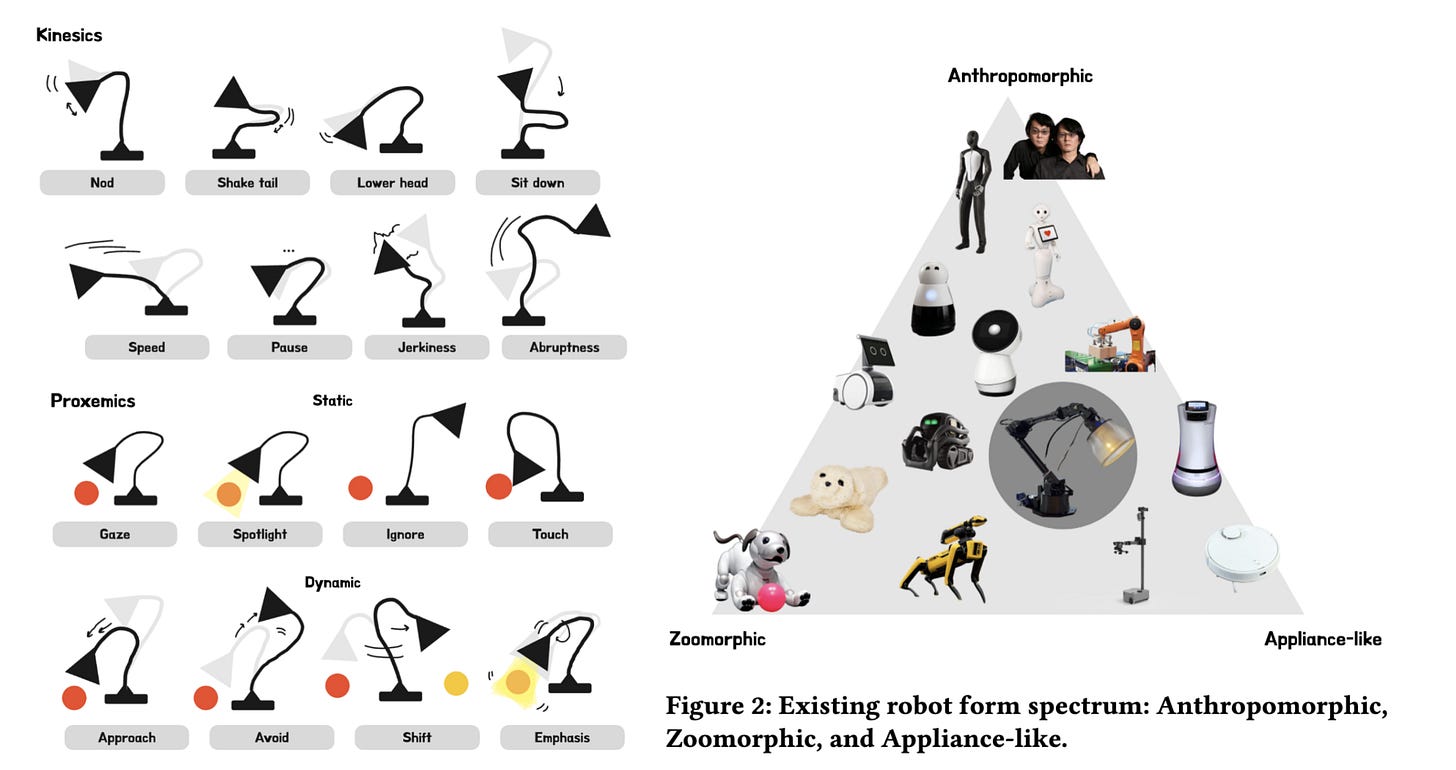
Apple’s Machine Learning Research team introduces Expressive and Functional Movement Design for Non-Anthropomorphic Robots—in simpler terms, bringing the Pixar lamp to life. In typical Apple fashion, the premise explored how non-anthropomorphic robots (robots that don’t look like humans) can integrate classical function-driven trajectories—where a robot moves from the initial state to goal state in the shortest, feasible trajectory—with motion that communicates intent, attention, and emotion to humans (i.e. expression-driven trajectory). The result is a really cool demo that looks a lot like the Pixar lamp in real life.
Boom Supersonic released their test results from the XB-1 test flight last week, demonstrating that supersonic flight is possible without an audible sonic boom. This is possible because of Mach Cutoff, a phenomenon where atmospheric temperature gradients cause shockwaves to refract upwards, preventing them from reaching the ground at certain Mach numbers (typically between Mach 1.0 and 1.15). The concept was first introduced by Lockheed engineers in the mid-1960s with recent testing by Boom and NASA researchers.
Honda is investing over $1 billion in Ohio facilities to scale up EV production, with a key focus on gigacasting. At its Marysville plant, the company is installing six 6,000-ton high-pressure die-cast machines—similar to Tesla's approach—to produce large structural components like battery pack enclosures. The Marysville facility, part of Honda's emerging EV hub in Ohio, is set to produce around 220,000 vehicles annually which includes the first Honda EV, an all-electric Acura RSX crossover.
Startup News 🚀
Pave Robotics, a startup developing robots for road maintenance with a focus on asphalt crack sealing to start, was recently accepted into YCombinator. You might recognize their work from YouTube—both founders, formerly the Head of Engineering and Head of Product at CrunchLabs (Mark Rober’s product company), have designed popular engineering toys used in STEM toy kits.
Presto is developing a software platform to streamline EV charging for fleets by integrating across various charging networks. The business is a classic platform/marketplace play, bridging the gap between fragmented charging networks and fleet operators to recommend the best available chargers in real-time. The company recently raised a $15M seed round to expand its operations and enhance its platform for fleets like Uber, Avis, Hertz, and Zipcar. The round was led by Union Square Ventures.
UVeye has secured an additional $191M in funding, bringing the total to $380.5 million, with the round led by Woven Capital, Toyota's growth fund. The investment will support UVeye's global expansion for their automated vehicle inspection system as the company aims to scan millions of vehicles annually.
Swiss startup Oxyle has raised $16M seed round to expand its innovative solution for destroying PFAS, known as "forever chemicals," in wastewater, building on a previous $3M pre-seed round. The company aims to scale the technology across various industries to treat 100 million liters of contaminated water in the next five years. The round was led by 360 Capital.
IONATE has closed a $17M Series A round led by AlbionVC, with participation from In-Q-Tel. The company’s hardware, a hybrid intelligent transformer (HIT), replaces old transformers with an equivalent that detects, analyses, and resolves power disturbances.