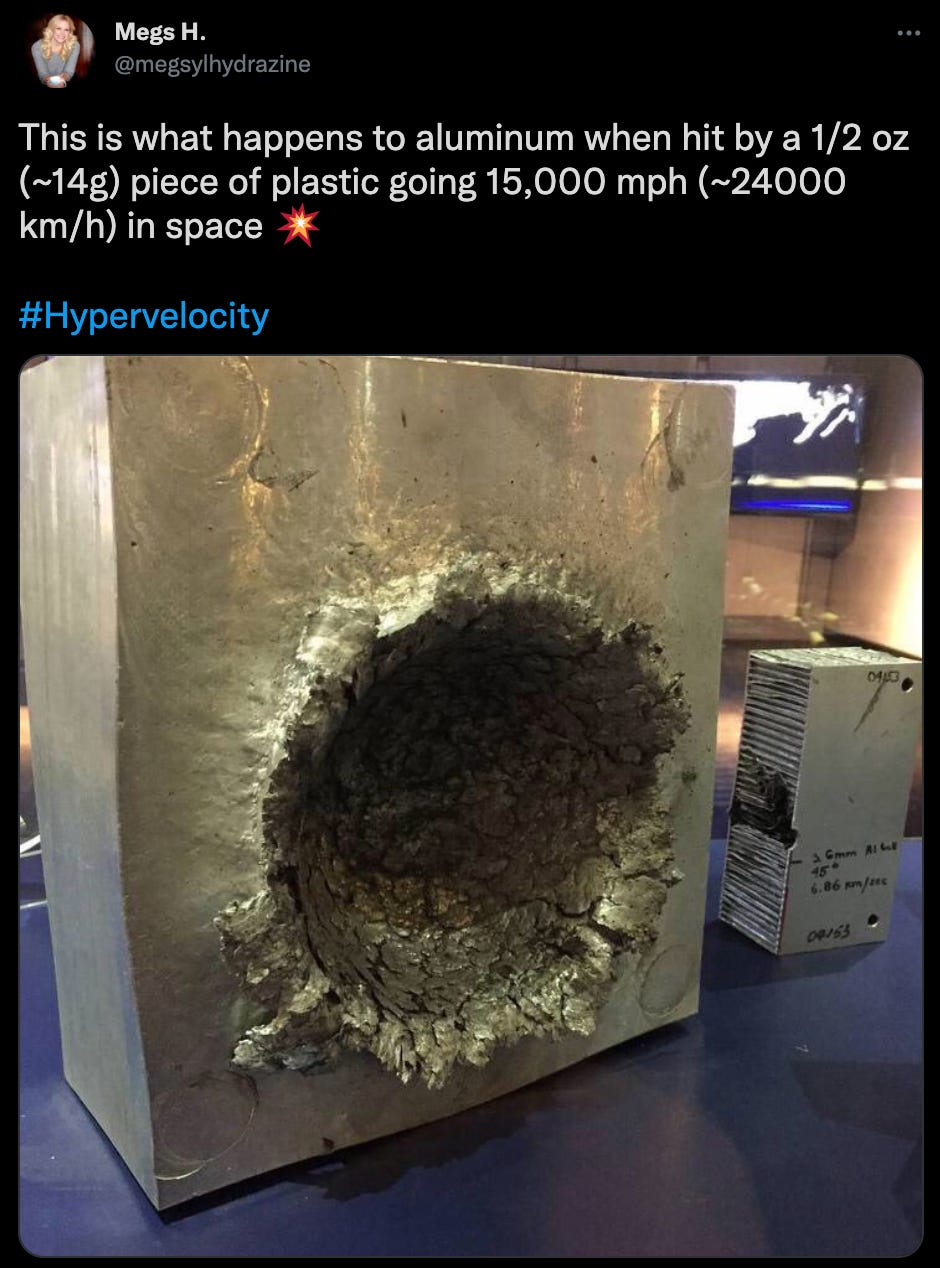
Highlights this week: 🚙 GM eliminating seat heaters, 🚜 an old, used tractor going for $175k, 💥 and space-plastic crashing at over 15,000mph.
🔗 Last week’s most-clicked link: A thorough antenna selection guide from Texas Instruments — what parameters to consider (and how) for various PCB, chip, and wire antennas.
Chip Shortage ➡️ Feature Shortage
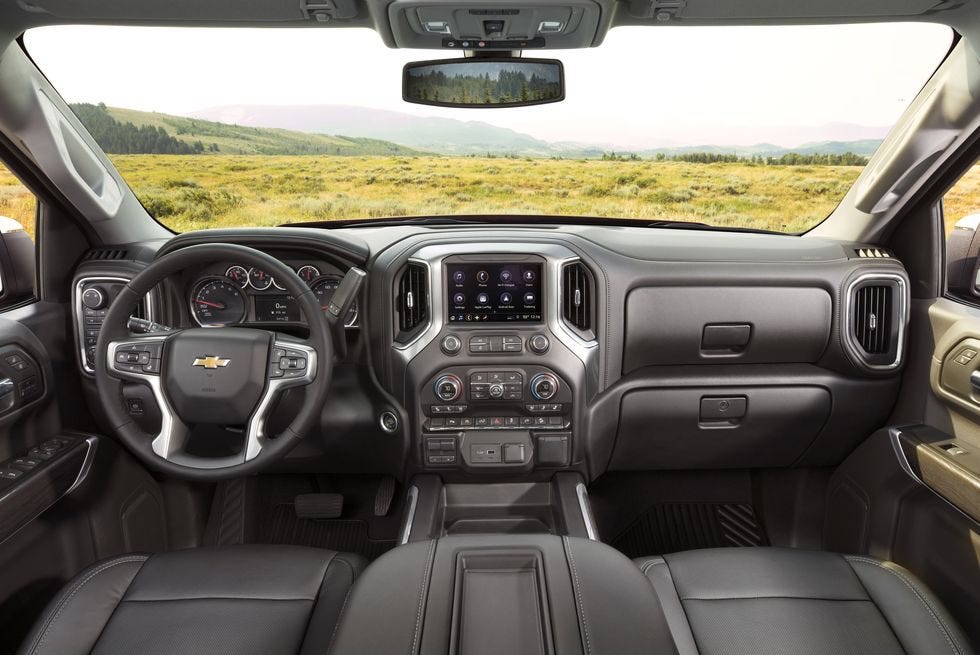
What’s happening: Manufacturers struggling with a shortage of semiconductor chips are finding workarounds -- redesigning products, shipping uncompleted units and focusing on older, lower-tech models.
Some background: The chip shortage is caused by issues at all stages of production: Basic building-block materials such as substrates are in short supply. Bad weather and natural disasters have interrupted wafer production. The final stages of manufacturing have been slowed by virus outbreaks and factory closures in Malaysia, a major semiconductor packaging hub. Some examples of older products and reduced feature-sets include:
- BMW removing touchscreen functionality across various 3, 4, and X models.
- Huawei using a mix of less advanced and powerful chips in its P10.
- Polaris shipping some snowmobile models without GPS screens.
- Cadillac eliminating the Super Cruise hands-free driver assistance technology from the Escalade SUV.
- Boss Products switching from a handheld smart-controller to a more analog joystick for their snow-removing machines.
- GM removing the HD radio option from its audio systems, and removing many of the heated and ventilated seats.
- Mercedes-Benz eliminating wireless phone charging pads, hands-free rear access systems, and some LED headlights (AMG models hit particularly hard).
- Porsche removing the 18-way adjustable seat option from the Macan SUV.
Dive Deeper:
- The automotive industry accounts for 37% of all semiconductor demand in Europe, and they’re lobbying hard for on-shoring more of the supply chain.
- Malaysia, a country with just over 30M people, accounts for 7% of the world’s semiconductor trade and 13% of the global OSAT (test) market.
Analog Deep-Dive: Anteros worth over $5T ☄️
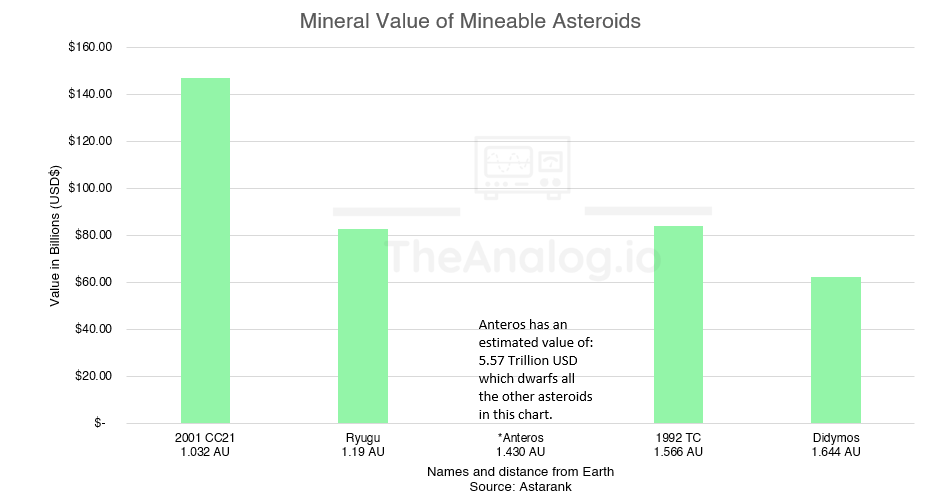
We publish deep-dives covering engineering topics, history, and companies each week! Read our GlobalFoundries thread on twitter.
Startup News 🚀💰:
- Planetary Systems, a space hardware company, was acquired by Rocket Lab for $42M in cash and nearly 2.5M $RKLB shares.
- Zoomo, an Australian e-bike startup, raised a $60M series B led by Grok Ventures, Skip Capital and ArcTern Ventures, and supported by AirTree Ventures, Clean Energy Finance Corporation, Contrarian Ventures, and Maniv Mobility.
- Cerebras Systems, an AI semiconductor company, raised a $250M series F ($4B valuation) led by Alpha Wave Ventures, along with Altimeter, Benchmark, Coatue, Eclipse, Moore, and VY.
- Level Home, a smart-home company, raised a $100M series C led by Cox Communication, along with Walmart. Level Home also acquired Dwelo.
- Sandbox VR, a location-based VR startup, raised a $37M series B led by Andreessen Horowitz.
- Modern Matter, a manufacturer of decorative and architectural hardware, raised a $1.2M seed round led by TiE DC, 757 Angels, and Rob Spillman.
- TIER mobility, a German e-scooter startup, acquired bike-sharing firm Nextbike for an undisclosed sum. TIER recently raised $200M.
- Mitra Chem, a lithium-ion battery materials product startup, raised a $20M series A led by Social Capital, along with Richard Tsai, Fontinalis Partners, Integrated Energy Materials and Earthshot Ventures
Interesting Links 🔗:
- In 1971, the Intel 4004 processor held 2,300 transistors and circuit line width was 10 microns, or 10,000 nanometers. The price was $200. Here’s a great video of Federico Faggin and Ted Hoff reminiscing about how they designed and architected the 4004.
- There is only one job out of the 270 jobs listed in the 1950 census that has since been completely eliminated by automation: the elevator operator. Jobs are more likely to change in response to the pressures of automation, like bank tellers after ATM’s.
- Russia tested an anti-satellite missile today that struck a Russian satellite and created a debris field in low-Earth orbit. So far, this has generated more than 1,500 pieces of orbital debris and will likely generate hundreds of thousands of pieces of smaller orbital debris. Kind of a big deal.
- Insane bidding wars are erupting across the US -- A John Deere tractor built in 1998(!). The bidding started at $100,000 and quickly shot up to a final sale price of $170,000. That’s $25,000 over the previous record for that specific model.
- There is some nuance behind the common guideline of voltage-derating capacitors. For ceramics, it has to do with increasing capacitance. For tantalum caps, it has more to do with power-on reliability. Here’s a great presentation on all things capacitors.
- Aluminum planes dissipate lightning without damage. To reduce weight (and therefore fuel consumption), next-gen aircraft are built from materials such as carbon fiber, which tend to have much lower electrical conductivity than aluminum. To protect against lightning, a thin layer of metal mesh or foil is added. This does the job, but adds quite a bit of weight.
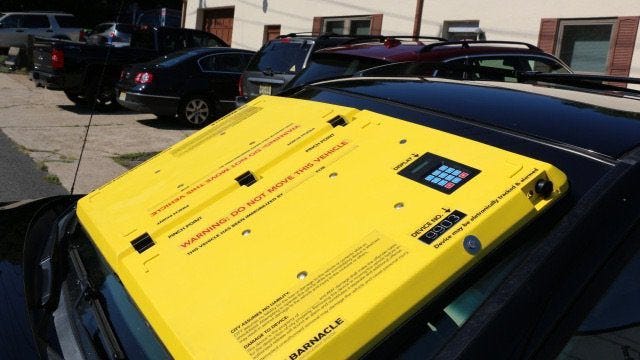
One Interesting Picture 📸: The Barnacle, for unpaid tickets, is held in place with suction cups that require a force of 750 pounds to release.
One Interesting Tweet 🐦: ke = ½mv^2