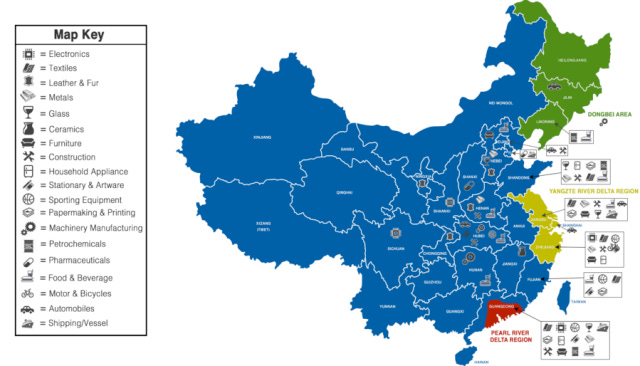
An industry-by-industry map of manufacturing distribution in China. The map shows how manufacturing is distributed across China's provinces, highlighting where different industries produce their goods. Some interesting observations:
Electronics: Manufactured in Guangdong (33% of distribution), with the rest in Yangtze River Delta region.
Textiles: Mainly produced in Zhejiang (18%) and Jiangsu (20%) provinces.
Motor & Bicycles: Around 40% of production is concentrated in Taizhou, Zhejiang.
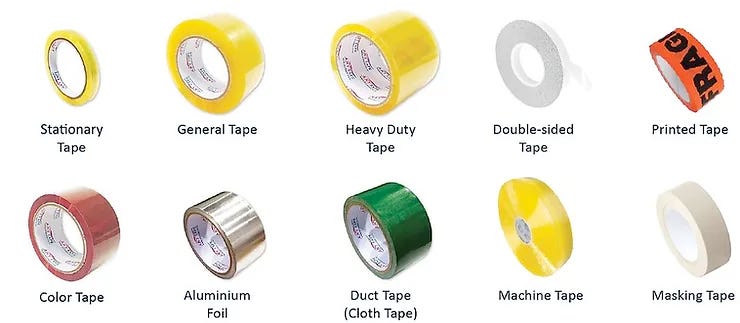
Everything you’ll ever need to know about the different types of tape. The video covers 20+ tapes commonly used for prototyping and engineering design, their characteristics, and primary use. Fun fact: aluminum foil tape is commonly used for sealing HVAC ducts and for shielding electronics from electromagnetic interference.
Thermal batteries, which store energy as heat, are emerging as a promising solution for grid-scale energy storage. With the potential to be 100x cheaper than lithium-ion batteries, these systems can store energy for hours or even days. Thermal batteries use materials like molten salt and heated rocks, and are particularly useful where a district heating system is already in place.
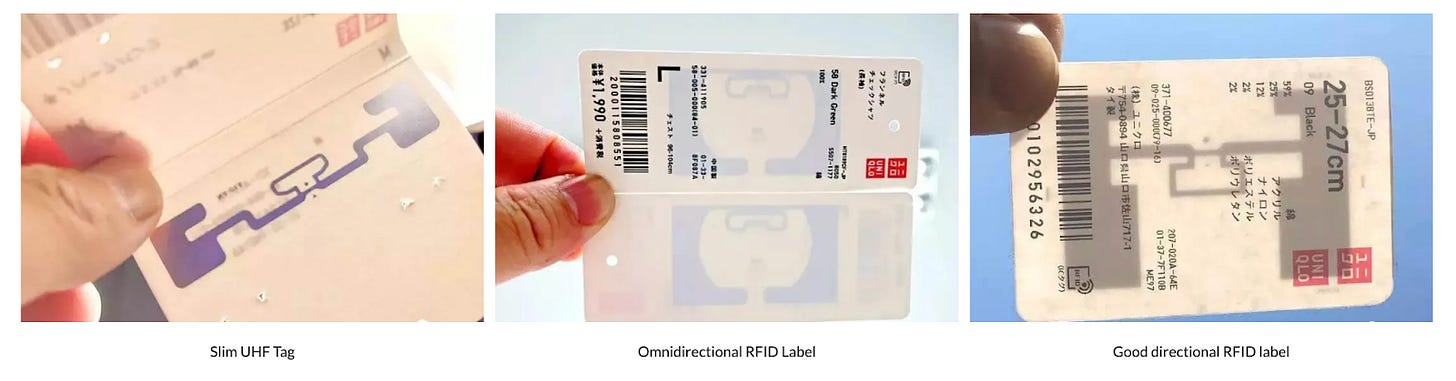
The same passive RFID technology used for authenticating passports also powers UNIQLO’s scanless self-checkout. Drop your items in the scanner, and it automatically recognizes them after passing through the ultra high-frequency (UHF) reader in the self-checkout machine. Estimated costs are ~4 cents/tag, a significant cost down from ~60 cents/tag decades earlier.
Passive RFID tags are small, battery-free devices (i.e. microchip and antenna in a flexible form factor) that use energy from a nearby reader to transmit data. When the reader emits radio waves, the antenna captures this energy, powering the chip to send back its stored information.
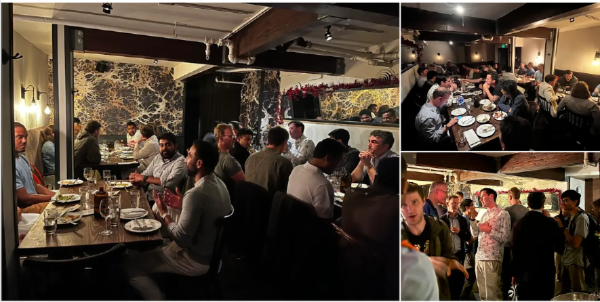
Hardware FYI Event in San Jose, CA 🗓️
Startup News 🚀
Mendaera has raised a $73M Series B round to continue development of a handheld robotic intervention platform. Instead of focusing on traditional surgical robots reserved for use in operating rooms, Mandaera is creating medical robotics for routine, everyday procedures. The company was founded by Josh DeFonzo, previous COO of Auris Health (acquired by J&J for $3.4 billion in 2019).
Pyka has raised a $40M Series B to develop its dual use, autonomous electric aircraft technology. Pyka currently has two products—the Pelican Spray for agricultural use, and the Pelican Cargo for transport. The Pelican Spray is currently the largest FAA-approved unmanned aerial system for agricultural use at 1,320 lbs.
Reflect Orbital, who recently went viral earlier this year for proposing a space-based ‘sunlight-as-a-service’ system, has raised $7.5M from Sequoia. Background on the investment: a Sequoia partner was on a plane with the CFO of SpaceX, and the two identified Reflect Orbital’s constellation of satellites as a potential whale user of the massive payload capacity enabled by Starship.
VELA has raised $43M of new funding and commenced construction of its new 100% wind-powered cargo ship. With funding led by arm's-length investment banks close to the French government, this is the first company to announce a cargo ship which is 100% wind-powered. While wind power has been used in cargo ship propulsion, it’s typically through retrofit systems that supplement traditional engines rather than replace them entirely.
Quantum Systems, a German drone startup focused on building aerial intelligence solutions for commercial and government use, raised an additional undisclosed tranche to its Series B which closed $63.6M of funding last year. The total funding in the round now exceeds $100M led by Notion Capital and Porsche SE. Quantum Systems develops advanced cross-industry drones technology.