Welcome to the second edition of Unraveling with Hardware FYI! As we’re releasing new content, the scope of the newsletter will be split up into three categories - landing jobs, industry tips, & hardware development lessons.
Today, we’ll be discussing how we had our own “aha” moment 💡 in discovering what’s most important in landing jobs.
What they don’t teach you in college 🤫
I was sitting in a Fluids Mechanics lecture my junior year, when it dawned on me.
One: I would probably never use any of this lecture material in real life.
Two: this material wasn’t going to help me land my dream job.
If you've ever sat in a class thinking the same thing, you're not crazy.
The truth is, much of what you learn in college does not directly translate to industry.
Fundamentals are super important— but your ability to solve a second order dynamics differential equation is so far detached from what will make you successful as an engineer!
The common argument for this focus on theory is that school is teaching you how to learn (which is partially true).
But there are so many industry relevant skill-sets (not taught at university) you can learn as a college student to separate yourself from your graduating class.
Out of the 200 students in that Fluids lecture hall, I'd guess that only 50 are now working in their ideal position, and only about 20 actually love their job.
Unfortunately, many ME grads end up working for large companies that are more concerned with maintaining shareholder dividends than innovating new technologies.
I knew that I wanted to build impactful products that would define our future, and advance my career by developing meaningful skills in the process.
Quite frankly, I was nowhere near being the best student, but over time I found that was irrelevant to landing a high paying, fulfilling job.
What actually matters:
These are the four things that actually matter:
- Understanding how to grow your network
- Learn by doing. Gain hands-on experience with personal/class/extracurricular projects relevant to your industry
- Framing your Pitch. Showcase your experience through a well-crafted portfolio & resume
- Learning the relevant fundamentals and industry-specific knowledge
(If you're able to accomplish these four steps, you can land a job at any company you want!)
So instead of getting perfect test scores at school, I decided to put more effort into recruitment, so that I could set myself up for a life I enjoyed once I graduated college.
This meant:
- Going to Fictiv and reading product tear-downs to understand how mechanisms in the latest consumer products were being designed.
- Learning the basics of electrical and software engineering to improve my ability to manage cross-functional tradeoffs.
- Reaching out to people on Linkedin who were exactly where I wanted to be in 1-2 years.
- Working on personal projects that I was genuinely interested and documenting the whole process (with lots of pictures!)

(I built a punch-activated flamethrower modeled after the same design from a popular Youtuber Allen Pan!)
The craziest part was, I was one of the only students in my class with this mindset.
Chances are, if you are reading this email, you’re probably one of the few in your class as well.
The truth is, most people tend to follow the status quo, and will go wherever the tide takes them.
It can be comforting to focus all of your effort into getting a 4.0 GPA at school—your professors, peers, and parents would probably commend you for it.
But you'll be in for a very cold shower come recruitment time if that's all you've focused on.
That’s why if you’re one of the few to be deliberate about your approach to job hunting you’ll be able to achieve your desired outcome.
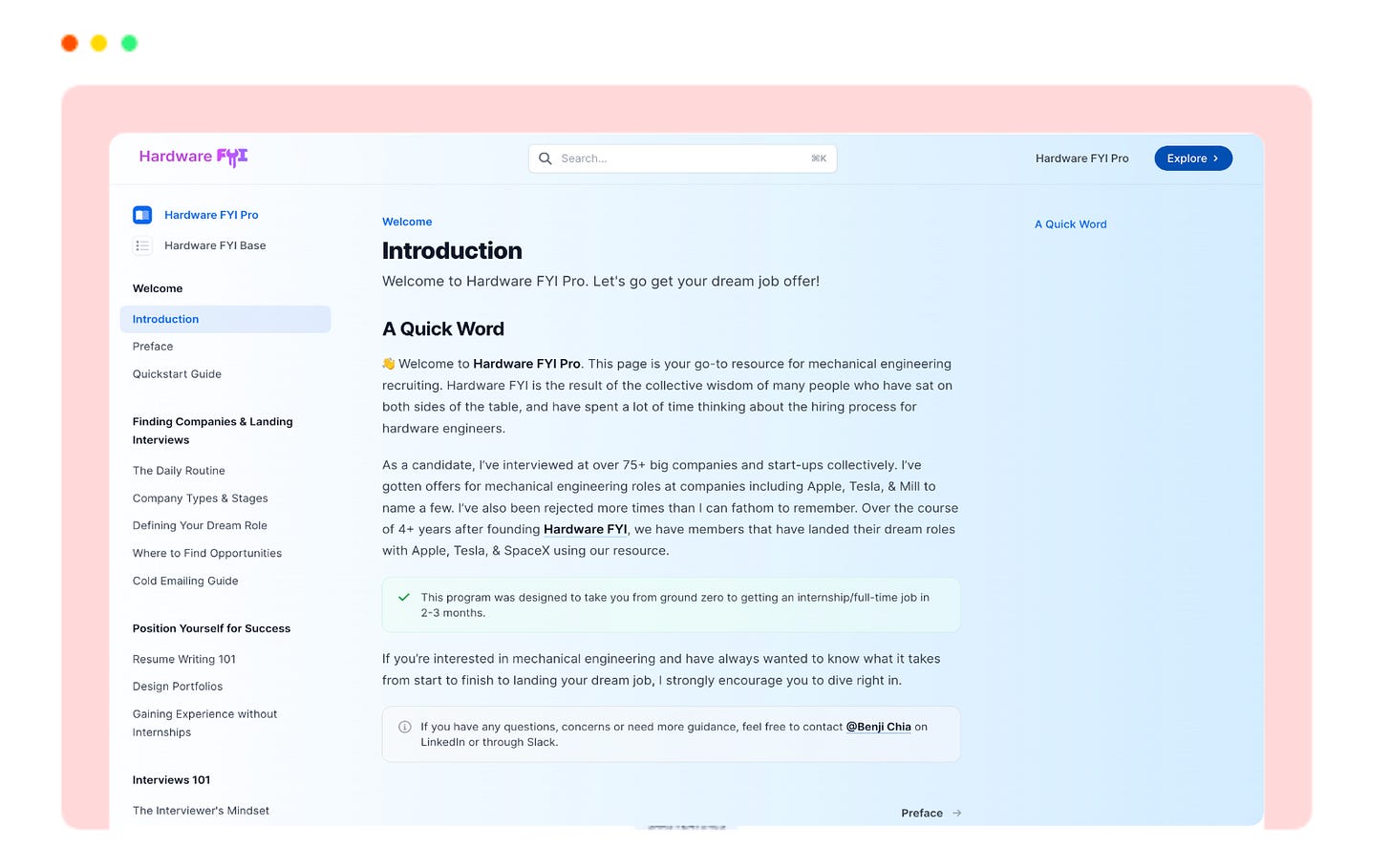
Jumpstart your Career with Hardware FYI Pro 📖
If you’re just getting started or looking to get a competitive edge, we’ve written a guide dedicated to helping you growth hack your career.
Our step-by-step guide will help you find companies and land interviews, provide insider tips, and give you the the most comprehensive knowledge base for mechanical engineering technical interviews.