Interesting Links 🏭
- A design tip for laser cutting parts at scale: optimize parts for a continuous cut path. Laser process time breaks into three components: pierce time (time to initiate the cut), cut time (tracing the programmed path), and move time (repositioning the head between cuts). On a recent visit to a partner manufacturer, Texas Metal Works noticed a street light pole baseplate where the bolt slots were integrated into the perimeter cut, and ran a test comparing it to a version with separate slots. The separate-slot design required six pierces per part, whereas integrating the slots reduced that to two. The end result: total process time dropped by 28%, mostly from eliminating pierces and head repositioning.

- The full history of electronics packaging, and how we got from simple wire bonds to stacked 3D chiplets. At its core, electronics packaging serves two jobs: protect the silicon and connect it to the rest of the system. That mostly consists of delivering power, moving signals, and managing heat. As transistors have scaled, packaging has become one of the biggest bottlenecks in moving data on and off chips. The latest shift is toward stacked chiplets and hybrid bonding, which allows direct copper-to-copper connections at sub-micron pitch. Instead of using solder bumps, hybrid bonding aligns ultra-flat wafers (or dies) and bonds both the copper and dielectric layers directly. This makes it possible to fit up to 10 million interconnections (individual connections for signals between stacked dies) in 1 square millimeter! SemiAnalysis also has a good deep dive on the topic of hybrid bonding.

- RobotsGuide.com is one of the most complete public databases of robots covering technical specs, photos, field videos, and even a few obscure prototypes you’ve probably never heard of. A couple examples that caught our attention: Astrobee, part of NASA’s Integrated System for Autonomous and Adaptive Caretaking (ISAAC), is a free-flying ISS robot with cameras and modular tools for inspection tasks. Less relevant today but equally interesting, the Nano Hummingbird was a DARPA-funded project developed by AeroVironment in 2008 that consisted of a 19-gram UAV with a video camera capable of short-range surveillance videos. A small spy bird, or technically speaking “a small, highly maneuverable, and stealthy surveillance tool capable of navigating complex urban environments.”
- Aerial Robotics Landscape is a read-the-docs style repo. that catalogs tools used in modern UAV development: flight stacks like ArduPilot (which has seen renewed attention in recent deployments), hardware like Pixhawk, and simulation environments like Gazebo and SITL. A drone’s core stack includes autonomy software, actuator control, onboard compute, simulation environments, middleware for hardware integration, and communication standards across subsystems. It’s one of the better places to start if you’re working with open-source drones.
- Traditional reverse osmosis (RO) desalination purifies seawater into fresh water, but requires a lot of energy to pump and filter biologically contaminated surface water. Pushing for higher recovery rates also concentrates the leftover brine which can harm marine life. Deep-water desalination like OceanWell’s system operates at 400m depth, using ambient ocean pressure to drive RO to pump fresh water onshore. This reduces energy use, lowers brine salinity, and draws from cleaner, colder water that requires minimal filtration.
- A couple fun links to round out the week:
- A spreadsheet breaking down nearly every mechanical engineering career—ranked by salary (median, 90th percentile, top reported), job stability, and what the work is actually like day-to-day. Put together by a friend who just launched a new YouTube channel.
- Musings on a maker's vs. manager's schedule, and why it's hard to build real work around calendar blocks.
Startup News 🚀
- Heron Power, an energy infrastructure startup founded by ex-Tesla exec’s, raised $38M in Series A funding to replace legacy transformers with solid-state power electronics that can connect modern energy sources directly to medium-voltage grids. Traditional transformers use passive coils and oil insulation to manage voltage but struggle with today’s bidirectional, variable loads. Heron’s solid-state system actively regulates voltage, frequency, and phase, improving stability as more solar, storage, EVs, and AI data centers come online with initial deployments planned for 2027. The funding was led by Capricorn with participation from Breakthrough Energy Ventures.
- Radiant Nuclear, founded by former SpaceX engineers, raised $165M in a Series C round. The company is developing Kaleidos, a 1MW portable nuclear microreactor that uses meltdown-proof TRISO fuel and helium cooling to replace diesel generators in remote areas. The U.S. Department of Energy recently allocated high-assay low-enriched uranium to Radiant, one of only five U.S. companies selected. In 2026, a test is planned at the Idaho National Laboratory’s DOME facility with the company aiming for full production by 2028. The round was led by DCVC.
- Saildrone raised $60M in funding to develop autonomous uncrewed surface vehicles (USVs) for maritime intelligence and ocean data collection. Their platforms, like the Voyager and Surveyor, use sensors and AI to monitor and survey oceans with over 1.6 million nautical miles logged. The funding supports European expansion, including new deployments for the Danish Armed Forces in the Baltic Sea. The round was led by BOND and supported by Capricorn’s Technology Impact Fund.
- FononTech, a semiconductor manufacturing startup,raised $9.5M in funding to finalize its Impulse Printing system for advanced packaging. The company’s process enables faster, lower-cost 3D interconnects for microLED displays and 2.5D/3D chip integration. FononTech has delivered its first machine to a major semiconductor customer and opened sales offices in South Korea, Japan, and North America. The round was led by Sake Bosch with participation from Innovation Industries.
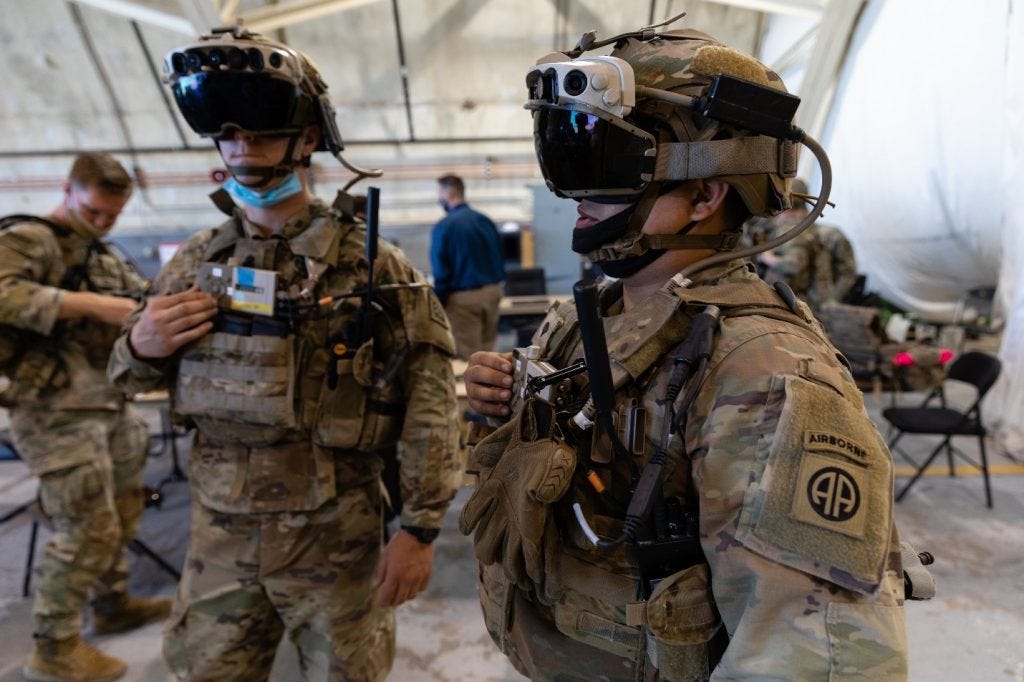
In a full-circle moment, Anduril is partnering with Meta Reality Labs (formerly Oculus) to build XR systems for the U.S. military. Some background: the Army’s $22B Integrated Visual Augmentation System (IVAS) program was originally awarded to Microsoft in 2018 to develop HoloLens-based headsets. Years of cost overruns and poor field performance led the Army to transfer prime contract control to Anduril, which had already integrated its Lattice AI platform into IVAS. Palmer Luckey, who founded Oculus and was controversially fired in 2017, now leads the program under Anduril with his old team at Meta.